Eight ways watch sellers get taken, and the tell for each.
Almost everything written about watch fraud is aimed at buyers worried about fakes. Sellers get targeted too, by a different and more profitable set of tricks. These are the ones that actually happen.
In this piece
Search for watch fraud and you will find a hundred guides on spotting a counterfeit Submariner. Almost all of it is written for buyers. The person carrying a real watch into a room full of strangers gets far less attention, which is unfortunate, because they are carrying the valuable thing.
None of what follows is exotic. These are ordinary, repeated events.
1. The bait and switch offer
You are quoted a strong number over the phone. You drive across town. At the counter, the number drops, and a reason appears: the dial is not original, the market moved this week, there is a mark the photographs did not show. You have spent an hour in traffic and the watch is already out of your pocket, so you take it.
The tell: the original number was never put in writing, and it was unusually high. Legitimate revisions happen, but only when the watch genuinely differs from what you described, and a legitimate buyer will show you exactly what they are looking at. Get the offer in writing, in advance, with the reasoning attached. An offer that will not survive being written down was never an offer.
2. The reversed payment
Payment arrives by a method that can be pulled back after the fact: a personal check that bounces a week later, a cashier's check that turns out to be counterfeit, a peer-to-peer app transfer reversed as unauthorized, a card payment charged back. The watch is long gone.
The tell: any pressure to accept a payment method the buyer chose and you do not control. The rule is simple and absolute. Funds must be confirmed cleared by your bank, not visible in your app, not accompanied by a screenshot, not "sent, just waiting on their end". Bank wires that have settled and cash counted in a bank branch are the two reliable methods.
3. The handling swap
The buyer asks to examine the watch. They turn it over, step slightly aside or hold it below the counter, and hand back a counterfeit of the same reference. You pocket it without close inspection. The discovery comes days later, when nothing can be proved.
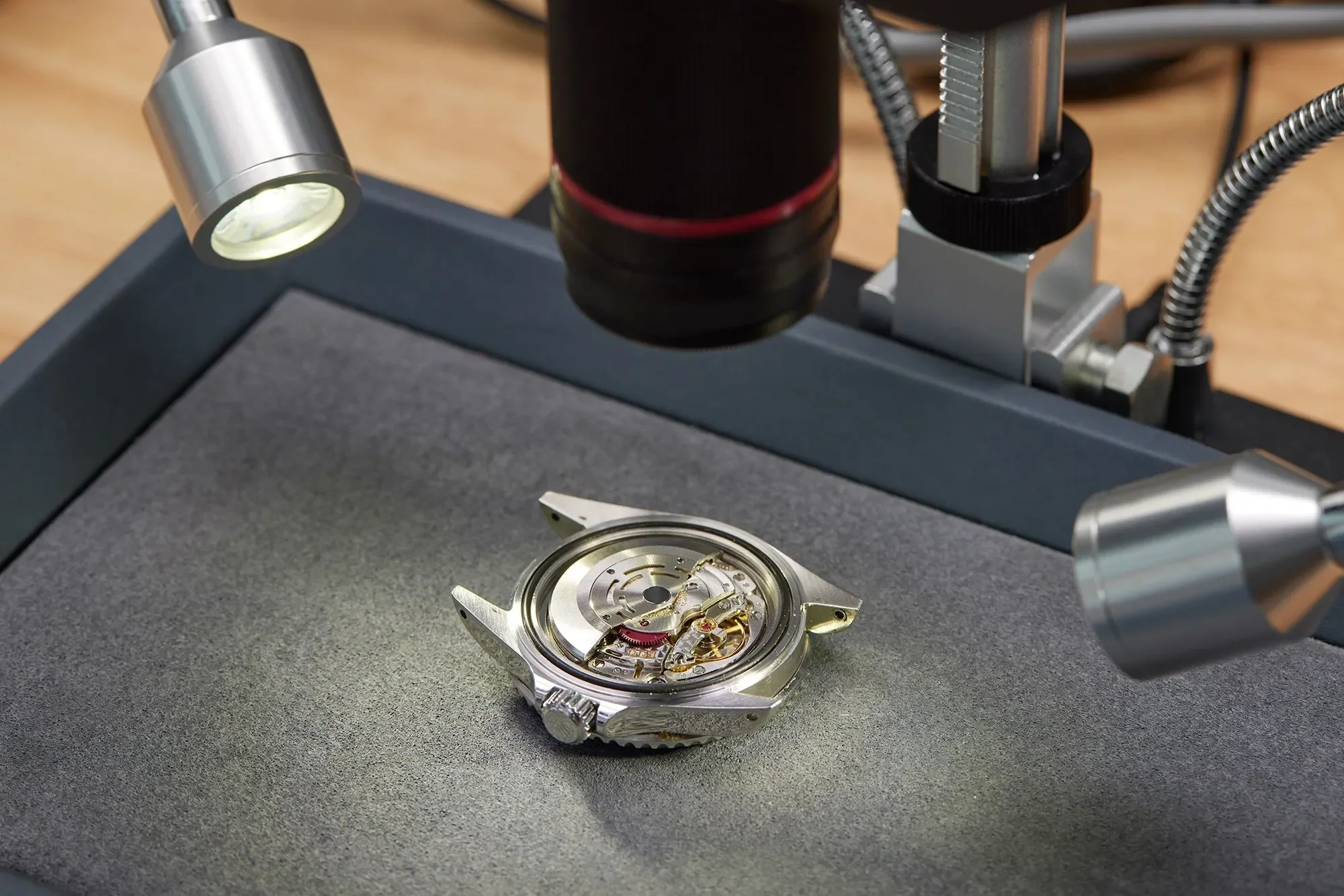
The tell: the watch leaving your line of sight, even briefly. Keep it on the table between you. If it needs to go under a loupe or a microscope, go with it. Note your serial number before any meeting and check it when the watch comes back. This is a thirty second habit that defeats the entire scheme.
4. The fake escrow
For a remote sale, the buyer proposes an escrow service and sends a link. The site looks professional. You ship the watch, escrow confirms receipt and promises release of funds, and then the site stops responding. The service was never real, and it was often created for you specifically.
The tell: the buyer chose the escrow service and sent you the link. Navigate to any escrow provider independently, and be suspicious of a domain you have never heard of that happens to be the only one the buyer will use. A buyer who refuses every alternative is telling you something.
5. The consignment that goes quiet
You leave the watch with a dealer to sell on your behalf. Updates are vague. Months pass. Eventually the business has changed hands, or the watch was "sold to a client" who has not settled, or it simply cannot be produced. This is more often disorganization and cash flow trouble than deliberate theft, which does not help you.
The tell: no written consignment agreement. Before the watch leaves your hands you need a document stating the serial number, the agreed floor, the split, who insures it while in their possession, and how fast you can demand it back. A business that resists putting that on paper is telling you how the arrangement will go.
6. The overpayment and refund
The buyer sends more than agreed, says it was an error, and asks you to refund the difference. The original payment is fraudulent and will be reversed. Your refund, sent by a method that cannot be reversed, is real money.
The tell: any overpayment, for any reason, followed by a request to send part of it back. This scheme is old and it works because it feels like you are doing someone a favor. There is no legitimate version of it. Return the entire payment through the same channel it arrived and start again.
7. The buyer who skips the paperwork
A buyer offers to skip the identification and the forms. It sounds like convenience, maybe even discretion. It is neither.
The tell: a licensed secondhand dealer in Florida is required to record the transaction, verify your identification and keep the record. A buyer who waves that away is either unregistered or intends to leave no trace of the transaction, and if your watch later turns up in an investigation, there is no record that you sold it legitimately. The paperwork protects the honest seller more than anyone. What the law actually requires.
8. The fake courier collection
After agreeing a sale, you are told a courier will collect. Someone arrives, produces a label, takes the watch. The buyer never sees it, or says they never did, and the tracking number belongs to a different parcel.
The tell: a collection you did not arrange and cannot verify. Book your own shipment, or use a prepaid label from a buyer whose offer you already hold in writing and whose identity you have checked independently. Hand the package to the carrier at their counter and keep the receipt. Never hand a watch to someone who arrives at your door for it.
Every one of these works the same way: it separates you from the watch, or from verified money, before the other side is secure. Hold both until one is certain.
The four rules that cover almost all of it
- Get the offer in writing before you travel. With the reasoning. An offer that will not be written down does not exist.
- Never let the watch leave your sight. Note the serial beforehand and check it afterwards.
- Funds clear before the watch moves. Confirmed by your bank, not by an app, a screenshot or an assurance.
- Insist on the paperwork. Identification, a transaction record, a receipt. If a buyer treats that as an inconvenience, leave.
Meeting in a bank branch solves several of these at once: there are cameras, there is a counter, and the people who can tell you whether a payment has actually settled are standing right there.
Common questions
- What is the safest way to get paid when selling a watch?
- A bank wire that has settled, or cash counted at a bank branch. The test is that your own bank confirms the funds are cleared and final before the watch changes hands. Payments visible only in an app, or accompanied by a screenshot, are not confirmation.
- Are cashier checks safe for selling a watch?
- Not by themselves. Counterfeit cashier checks often clear provisionally, so the money appears in your balance before the bank discovers the forgery and reverses it, leaving you liable. Wait for your bank to confirm final settlement.
- How do I avoid a watch being swapped during inspection?
- Record your serial number before the meeting, keep the watch in view at all times, and check the serial when it is handed back. The swap depends entirely on the watch briefly leaving your line of sight.
- Is it a bad sign if a buyer does not ask for ID?
- Yes. A registered secondhand dealer in Florida is required to verify identification and record the transaction. A buyer skipping it is either unregistered or avoiding a record, and the record is what proves you sold the watch legitimately.